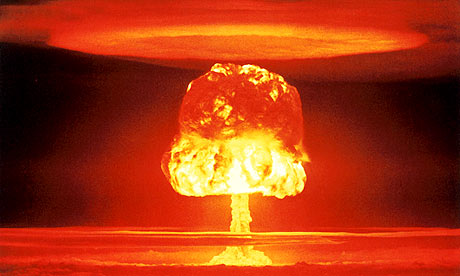
 America will be shitting its pants—and it should be—over the new film BONFIRE: DREAMS OF WORLD WAR III.
I’m having a bit of a heart attack writing about its disturbing, every-crisis-at-once believability.
BONFIRE takes place amid the backdrop of a slowly-building pandemic and a subsequent technology crisis that may or may not be the result of a cyberwar. Nevertheless, throughout the panicked narrative, devices of every kind cannot be relied upon because of this either natural-or-unnatural glitch. This betrayal of everything against everything merely sets the background for a more full-frontal assault.
A movie is not, perhaps, the best place to learn practical methods of taking over the presidency, but that appears to be what’s happening in this new action thriller, which could, in some fevered imaginations, very well inspire a real-life coup d’etat. You wonder if it already did.
Played with shocking aplomb and intelligence by newcomer Daniel Schott, who comes largely from German films (and pulls off a flawless Texas accent), the character of Secret Service bodyguard Patrick Janus is a truly complex patriot.
Summoned to the Naval Observatory outside of his working hours, Janus meets with members of the cabinet in a secret meeting that is nothing less than the formation of an attack on the current President of the United States by members of his own White House.
It seems the Chief of Staff has a problem.
Talks with North Korea have broken down. We have a President that is out of control, is probably psychologically unstable, and only a majority vote of the cabinet can remove him from power.
The cabinet agrees on his removal due to mental incapacity under the 25th amendment, but they know for certain the President will not leave quietly.
The President may already be planning removal of key cabinet officials to ensure his position.
Janus himself has observed the President behaving in erratic and disturbing ways since his narrow election.
He has close knowledge of the dangers of this man.
Impeachment is out of the question because the President has confidential, damaging files on several major members of Congress who will never move forward on removing him.
In a clever reversal of the classic SEVEN DAYS IN MAY, the cabinet wants Janus, one of the President’s own protectors, to appear to lose it, go rogue, and assassinate the President.
Furthermore, they want him to go all the way, to take the rap and go to prison, so that the conspiracy is not discovered.
They will protect him in federal prison, and offer him the possibility, much later, of a faked death and comfortable escape.
The clock is ticking because the President is becoming more convinced of the need of an attack on North Korea, both for paranoid national security reasons and to create a surge in his own political support.
Absolutely no one thinks a nuclear attack on North Korea is necessary or justified.
But he is the Commander in Chief.
If he orders an attack, it will likely be carried out and millions will die, endangering the US from a retaliatory strike.
So, in the very surprising yet plausible opening minutes, Janus takes on the mission.
He is not at all a reluctant hero, and Schott completely pulls off the performance credibly.
After all, he is doing what is right for his country and the Constitution first: the cabinet has the right of removal, and the President is obstructing Constitutional procedures.
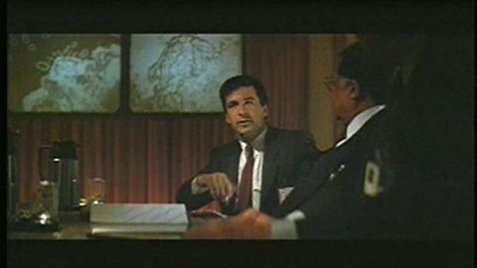 Movies like Hunt for Red October (screen grab) have believability like this, but don’t always deliver on action.
This is an agent who has already been sweating over the morality of his position, and who has seen, in meeting after meeting, the ill-prepared and erratic elderly President make shocking remarks and even admissions that suggest our leader may have done some unnerving crimes. Agent Janus has been plagued by highly realistic nightmares of a World War III which he could have prevented, and on this rainy Washington DC night, he is given the chance to alter that vision of the future.
He takes the job.
Now he faces an immediate and huge problem.
The President has a small but intensely loyal private military force.
Janus is going to have to get through them.
Now, movies like THE HUNT FOR RED OCTOBER, PATRIOT GAMES, THREE DAYS OF THE CONDOR, or even RED SPARROW use elements of historical truth and a believable tone to create an impact, but BONFIRE delivers both on this and on the high-powered action that audiences expect after THE BOURNE IDENTITY and SICARIO, where plausibility is the desired ambience but a satisfactory body count is also obligatory.
I don’t know when I’ve ever held my breath this long.
Janus has no time to prepare. The next day he reports to work, relieving the President’s primary security detail, and gets psychologically ready for this extraordinary action, minute by minute as the Commander in Chief goes through his daily routine. Janus is shaking from adrenaline and fear and realizes this will not be simple. He arouses the suspicions of several of the President’s elite auxiliary guard, made up of his own ex-Navy SEAL bodyguards uncomfortably sharing responsibilities with the Secret Service.

Photo credit: Stephen Rabloid/Amazon

Matthias Schweighöfer, an actor who resembles the lead (since no photos have been released from BONFIRE)
Photo credit: Amazon.com
At the beginning, this is a film of minimalist gestures, where baritone men in quiet argument convey extreme gravity and menace and yet we learn little about the people involved; we are simply a fly on the wall. It’s a testament to the variety of character actors in this that you imbibe each advance in the plot without much resistance, and the worried, mind-on-overdrive performance of Schott sells the entire thing with at least as much confidence as Robert Redford in ALL THE PRESIDENT’S MEN or CONDOR, which, when you think about it, offered little evidence of the man’s background and worldview aside from what happened as the story drove relentlessly forward.
In the middle, however, everything accelerates.
Probably the most original aspect, aside from a feel that distinguishes it from WHITE HOUSE DOWN and that kind of hamfisted movie, is the setting. Agent Janus gets his lethal opportunity during a tour of the Smithsonian Institute. This creates a marvelous collection of setpieces.
 From the Smithsonian museum website, no copyright herein asserted, all rights reserved to original owners.

What follows is a series of quick, real-time run-and-gun sequences played against the treasures of the Smithsonian Air and Space Museum. The director, a commercials veteran, plays these scenes for suspense, not action, and it works with heart-stopping effect.
Surprise after surprise fills the second act. The protection of the President is not done by mindless goons but a capable crew with a long history together and friction with each other over something that went down in Iraq—but despite them, Janus shockingly nails the target.
Killing the President is horrifying to him and not a mission he relishes. But he’s done it.
The President falls back against a taxidermis lion, blood spattering the pelt in a memorably off-kilter death scene.
Now Janus tries to escape in the chaos, but is eventually apprehended on the DC streets in a car chase that utilizes slippery, snowy streets.
You really have an oh shit moment when he gets captured because he has no possible alibi. And the world they’ve set up makes it obvious he cannot just Rambo his way out of this. Janus is caught. He’s done.
And then I swear to you the story escalates.
As he is processed through the court system and a gauntlet of frenzied media agents, he begins to realize he has assisted a Vice President who may be every bit as dangerous if not more so than the man he removed.
This is that perfect moment in a movie when everyone in the audience wants to giggle with anticipation but the tension is literally too much.
See, Vice President Colson uses the attack as a pretext for martial law in Washington while key members of the House are mysteriously unaccounted for, perhaps because of innocent reasons such as the illness sweeping the nation–or perhaps not.
Meanwhile, the military operations against North Korea may be put on hold, but attacks on their backers in Russia may be imminent because the Vice President—now in charge—stands to win billions from his army contractor investments as well as gain instant legitimacy as he faces down a national enemy.
Janus has to interpret all this while he goes through arraignment and then is transferred to another jail awaiting trial. He will have to break out of confinement, cross a city embroiled in chaotic protests and National Guard movements, and do something about a new President who is rapidly consolidating power in a thrust toward World War III.
It’s riveting. If it sounds like it’s over the top 24 Kieffer Sutherland-type action, it’s actually not. What makes it work most is the turmoil in the cabinet, where Janus has several reasonable supporters. There’s hope throughout this thing, but it’s closing so fast you cannot relax for a second.
Periodically, throughout the film, Janus has nightmares and memories of terrible dreams about World War III and what it might look like. These war scenes are so vivid and credible—utilizing real locations in Korea where incoming soldiers and nuclear blasts are rendered in new and realistic ways—that the movie should have people sort of in shock from the trailer candy alone. After all, this is not so far from real headlines.
I have never found these kinds of movies so involving, but BONFIRE is an exception.
But now this whole review is pointless.
Because here’s the real punch to the gut.
You won’t get to see this movie.
Despite being screened for us and 9 other critics from both the internet and print media, the film has now been blocked from release because of legal maneuvers by a certain former President who does not want this movie to be seen. These are rumors, admittedly, but the Washington Post has compiled a lot of circumstantial evidence that the source of the lawsuits between the producers and the studio which have kept the movie from coming out is most likely the current White House itself. Why that is remains unclear.
This leaves us with an amazing moment in history, where a film about Washington characters who construct a conspiracy based on a 1960s movie like SEVEN DAYS IN MAY are themselves mirrored in a real White House that would like to bury this plot forever.
The L.A. Times is reporting that BONFIRE is causing considerable fights within D.C. itself.
Was this inspired by secret events that didn’t quite work out, or is it pure fiction?
Time will tell.
But we aren’t going to want popcorn as we watch the truth unfold.
Brace yourselves, my fellow Americans, things can always get worse.
_____
Update: The last line is no joke. Netflix has expressed interest in purchasing BONFIRE from its theatrical distributor to be shown immediately, followed up the next night with a documentary on the effect the film has had, in causing what could be actual revolutionary protests in D.C. from all the different sides of this strange conspiracy and covering the intense investigation to find out who actually wrote the movie. Did somebody lay out plans for a revolution, and are those plans still available to use against other presidents? Disturbing idea. Hold on to something. It’s going to get interesting.

